Forex trading for beginners versus waiting for a perfect moment, which path builds skill faster
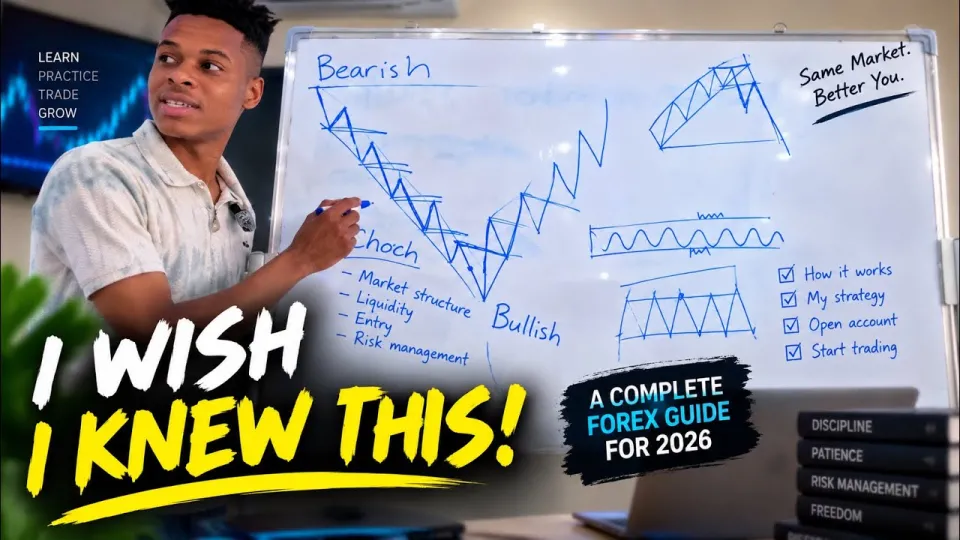
Video: How To Start Forex Trading For Beginners in 2026 (Full Guide + My Strategy)
You can order the same kind of articles for your own video to boost it on YouTube and Google. Just message the Telegram bot @sat_sit_bot. It writes articles around your video, embeds the video and publishes them on popular niche websites (no ads). Try it free: 50 articles on us.
· based on the channel Carl Fx
Forex for beginners is best learned as a repeatable process rather than a hunt for a winning indicator: open a demo account, study market structure on a single currency pair, risk a fixed small percentage per trade and journal every entry. That sequence turns trading from guessing into a measurable skill, and it is the same foundation Carl Fx lays out in his beginner walkthrough on the TFC Global Markets registration page, where the account is opened and the practice begins.
What forex trading actually is and how the market is structured
Forex is a decentralised over-the-counter market where currencies are traded in pairs, and the price of a pair simply tells you how much of the quote currency one unit of the base currency costs. EUR/USD at 1.0850 means one euro buys 1.0850 US dollars; the first currency is the base, the second is the quote. Because there is no central exchange, banks, funds, brokers and retail traders deal through an interbank network, and retail access comes through a broker that routes orders into that liquidity.
Three mechanics decide how a beginner experiences this market:
- Pips and lots. A pip is the standard smallest price increment, usually the fourth decimal for most pairs and the second decimal for yen pairs. A standard lot is 100,000 units of the base currency, a mini lot is 10,000 and a micro lot is 1,000, which is why micro lots are the practical starting size.
- Leverage. Leverage is borrowed exposure expressed as a ratio, such as 1:30 or 1:100. It does not increase the probability of a winning trade; it only increases the size of the outcome, including losses.
- Sessions. Liquidity concentrates in the London and New York sessions, while the Asian session is typically quieter. Beginners usually get cleaner structure and tighter spreads during the overlap of London and New York.
The market is open 24 hours a day from Monday to Friday, which means the real constraint is not access but discipline: someone has to decide when not to trade.
How to open a trading account and what to check before funding it
Opening an account takes minutes, but the checks around it decide whether the account is worth having. The typical flow is registration, identity verification, account type selection, demo practice and only then a live deposit.
- Register and verify. Complete the sign-up form, upload the identity and address documents the broker requests, and wait for approval before sending money.
- Choose the account type. Standard accounts usually trade from 0.01 lots with no commission and a wider spread; raw or ECN-style accounts offer tighter spreads with a per-lot commission. For a first account, the simpler spread-based model is easier to reconcile.
- Test the demo. Place at least 20 trades on demo using the same lot size and rules planned for live trading. A demo traded carelessly teaches nothing.
- Fund small. Start with an amount that can be lost without affecting daily life, because the first months are tuition, not income.
- Check regulation, withdrawals and platform stability. Confirm which regulator supervises the entity you sign with, how withdrawals are processed and whether the platform holds up during news releases.
Carl Fx is transparent that he owns TFC Global Markets and that his sign-up link promotes his own brokerage, which is worth knowing before clicking any affiliate link from any creator.
Reading bullish and bearish markets through market structure
Market structure is the map of who is in control, and it is read from swing highs and swing lows rather than from indicators. In a bullish market, price prints higher highs and higher lows; in a bearish market, it prints lower highs and lower lows. When that sequence breaks, the market is either ranging or changing direction.
A practical way to apply it:
- Mark the most recent obvious swing high and swing low on the higher timeframe, such as the four-hour or daily chart.
- Label the trend: rising structure means you look for longs, falling structure means you look for shorts.
- Wait for price to pull back into a zone rather than chasing a candle that has already moved.
- Treat a clean break and close beyond the last swing point as a signal that the structure may be shifting, not as an instant reversal trade.
Price action then adds the trigger: rejection wicks, engulfing candles or a break of a small consolidation inside the pullback zone. The point of structure is to stop taking trades in both directions on the same chart, which is the fastest way for a beginner to donate money to the market.
A simple beginner strategy built on trend, zone and fixed risk
A workable starter strategy needs only a direction filter, an entry zone, a stop and a target, and it must be written down before the trade. One straightforward version uses structure plus a pullback.
- Direction filter. On the four-hour chart, confirm higher highs and higher lows for longs, or lower highs and lower lows for shorts.
- Zone. Identify the area price last left quickly, such as the origin of the impulse leg or a previous consolidation.
- Trigger. Drop to the 15-minute chart and wait for a rejection or a small structure break in the direction of the higher-timeframe trend.
- Stop loss. Place it beyond the swing that invalidates the idea, not at a round number chosen for comfort.
- Target. Aim for at least twice the risk, and move to break-even only according to a pre-written rule.
- Risk. Cap each trade at 1% of equity and total open risk at 3%.
One setup, one pair and one timeframe combination is enough for the first months. A trader who logs 50 trades of a single strategy learns more than one who samples ten strategies in a week.
Mistakes that cost beginners the most money
Most early losses come from process failures rather than bad analysis, and they repeat across almost every new trader. The most expensive ones are oversized positions after a win, revenge trades after a loss, moving a stop loss to avoid being wrong and trading during high-impact news without a plan. Others are subtler: switching strategies after three losses, following signal groups without understanding the setup, and treating a demo account as a game.
A second cluster is technical. Beginners trade too many pairs at once, ignore spreads and swap costs on positions held overnight, and confuse leverage with position size. There is also the arithmetic problem: risking 10% per trade means five consecutive losses cut the account roughly in half, and five-loss streaks are normal even for profitable systems.
Finally, there is the expectation problem visible in the comments under beginner guides, where new traders announce a start date and hope for a fast result. Trading rewards consistency over months, not a single good week, and anyone who treats it as a shortcut around learning will usually pay for that shortcut.
Common beginner questions answered from real audience doubts
The questions that come up most often under beginner forex content are practical rather than theoretical, and they deserve direct answers. New traders want to know whether they need a large deposit, whether a demo account is a waste of time, how long before going live and what to do when the platform will not let them open a real account.
On deposit size, the honest answer is that the amount matters less than the risk percentage: a 500-dollar account risking 1% per trade risks 5 dollars, which is small but teaches the same habits as a larger account. On demo, it is only a waste of time if it is traded without rules; used with a journal and fixed lot sizes, it is the cheapest feedback loop available. On timing, a reasonable benchmark is three consecutive profitable months on demo with a written plan, not a fixed number of days. On account-opening friction, verification documents, regional restrictions and payment methods are the usual culprits, and support should be asked directly rather than guessed at.
Another recurring theme is comprehension: some viewers admit they cannot yet grasp the material. That is normal at the start, and the fix is narrowing the scope to one concept per week rather than consuming more content.
Useful links
- Open a trading account with TFC Global Markets — the broker registration link shared by Carl Fx, who discloses ownership of the brokerage.
- Join the free Telegram community — the channel where Carl Fx shares trade discussion and updates.
The realistic path from first demo trade to funded account
Forex rewards a boring, repeatable process far more than a clever entry, and the beginner who accepts that early saves both money and time. Learn how pairs are quoted, read market structure on a higher timeframe, pick one setup, risk 1% per trade and journal everything; those five habits carry more weight than any indicator. Start on demo, prove the process over dozens of logged trades, then fund a small live account and let the record decide whether to scale. Carl Fx builds his beginner guide around exactly this order, and his TFC Global Markets sign-up link is the practical starting point he offers for opening the account. Trading involves significant risk and profits are never guaranteed, so treat every position as a cost you have already accepted.
Key takeaways
- Forex is an over-the-counter market of currency pairs quoted in a base/quote format, such as EUR/USD, where price moves in pips.
- A beginner should risk no more than 1% of account equity per trade and keep total open risk under 3%.
- Market structure is read through higher highs and higher lows in an uptrend and lower highs and lower lows in a downtrend.
- A demo account costs nothing and should be traded with the same position size and rules as a live account for at least 30–50 logged trades.
- Broker choice matters: regulated execution, transparent spreads and a working demo are the minimum before depositing real money.
Questions & answers
How much money do I need to start forex trading?
There is no fixed minimum, but the risk percentage matters more than the deposit. A 500-dollar account risking 1% per trade risks 5 dollars per position, which is small yet teaches correct sizing. Larger accounts simply make the same mistakes more expensive, so start with an amount you can lose without changing your life.
Is a demo account worth it or should I go straight to live trading?
A demo account is worth it when it is traded with the same lot sizes, rules and journal as a live account, because it provides free feedback on your process. It becomes useless when positions are opened randomly for entertainment. A common benchmark is three profitable months on demo with a written plan before funding.
What is market structure and why do beginners need it?
Market structure is the pattern of swing highs and swing lows that shows which side controls price: higher highs and higher lows in an uptrend, lower highs and lower lows in a downtrend. Reading it stops beginners from buying and selling the same chart in both directions. Entries then come from pullbacks into zones rather than from chasing candles.
Why can it be difficult to open a real trading account?
Most problems come from identity verification, missing documents, regional restrictions or payment methods that the broker does not support for your country. The fix is to read the requirements before registering and to contact support directly. Affiliate links from creators also mean the account may be tied to a specific partner, so check the terms first.
Source: How To Start Forex Trading For Beginners in 2026 (Full Guide + My Strategy) · Markdown version